The Netherlands might seem easy enough to navigate: flat landscapes, clear roads, and drivers renowned for their courtesy. Yet beneath that calm surface lies a network as carefully designed as its wider ; a system built on discipline, precision, and shared understanding.
This guide covers the routes from Britain to the Netherlands, the essentials of Dutch road culture, and the practical considerations that ensure a smooth and safe journey.
How to Drive from the UK to the Netherlands

Most travellers begin their journey not on a motorway, but on the water. Several routes connect Britain directly with Dutch ports, while others weave through France and Belgium, offering flexibility for different budgets and itineraries.
Direct Crossings

Three ferry routes link the UK directly to the Netherlands:
- Harwich → Hook of Holland (Stena Line)
The most direct option from southern England. Stena Line operates two daily sailings, typically a morning departure and an overnight crossing in the evening. The journey takes around 6½–8 hours depending on schedule and conditions. The overnight service remains a favourite among seasoned travellers: board in the evening, dine onboard, sleep, and disembark after breakfast ready for the short drive into the Randstad region. - Hull → Rotterdam Europoort (P&O Ferries)
A strong choice for travellers from the North or Scotland. P&O operates daily overnight sailings, with the crossing taking approximately 11–12 hours. Cabins are standard, and arrival places you under an hour from Rotterdam and roughly two hours from Amsterdam. It’s efficient if you want to cover distance while you sleep. - Newcastle → IJmuiden (Amsterdam) (DFDS Seaways)
A longer overnight passage of around 16 hours, typically sailing once daily with additional peak-season departures. The route runs from the Tyne to IJmuiden, a port just west of Amsterdam. It’s ideal for those who prefer to avoid the drive south through England entirely, trading road miles for time at sea.
These crossings are designed for motorists: cabins for rest, deck space for vehicles, and efficient disembarkation into well-marked Dutch motorways. The seas are usually calm, though advance booking is wise, especially in summer.
Via France and Belgium

For many drivers, particularly in southern England, the most flexible route to the Netherlands is via Dover. Both ferries and the Eurotunnel operate on this corridor at very high frequency.
Ferries to Calais and Dunkirk run throughout the day and night, with departures typically every 30–60 minutes. Crossing time is around 1 hour 30 minutes. In peak periods, multiple operators mean dozens of sailings per day.
The Eurotunnel shuttle from Folkestone to Calais runs 24 hours a day, often with several departures per hour. The crossing takes approximately 35 minutes, making it the fastest way across the Channel.
The key advantage here is flexibility. Unlike the longer North Sea crossings from Harwich, Hull, or Newcastle, you’re not tied to a single daily sailing. If traffic delays you on the M20 or A2, another departure is rarely far behind.
From Calais or Dunkirk, the onward drive north through Belgium into the Netherlands is straightforward: wide, toll-free motorways, well-signed service areas, and flat terrain that allows steady progress. Rotterdam is typically around 3–3½ hours from Calais, Amsterdam closer to 4–4½, depending on traffic around major cities like Antwerp and Rotterdam.
It’s a longer drive overall, but often the cheapest way to travel by car. It also opens up options: a night in Bruges, a stop in Ghent, or a detour through Zeeland’s causeways. For those planning a broader journey through Europe, you should read this article: Planning a Road Trip from the UK to Europe.
Driving Between Cities in the Netherlands

Dutch roads are shaped by thoughtful design. Every lane, junction, and cycle path reflects a national philosophy: that movement should be safe, predictable, and shared. On motorways and ring roads, expect wide carriageways, clear lane markings, and orderly traffic flow. In outer districts of major cities, roads remain broad and well structured.
As you move closer to historic town centres, however, space narrows and activity intensifies. Streets tighten, trams share the carriageway, and cyclists and pedestrians converge at junctions. In older cities especially, driving becomes more concentrated and deliberate.
Right-Hand Roads and the Basics
The most immediate change that takes a little getting used to is driving on the right. Overtaking is on the left, and roundabouts flow clockwise. Yet the adjustment is less daunting than many expect. Motorways are clearly marked, and urban layouts are logical. Dutch drivers tend to be precise rather than aggressive; they respect lane discipline and rarely block overtaking lanes.

Speed limits are expressed in kilometres per hour, and enforcement is strict.
- Motorways (Autosnelwegen): 100 km/h by day (06:00–19:00), 120–130 km/h by night.
- Rural roads (N-roads): usually 80 km/h.
- Urban areas: 50 km/h unless signposted otherwise.
Cameras are common, often integrated into overhead gantries rather than visible on poles. Spot fines arrive by post, even for modest excesses, so it pays to watch for limit changes, especially near junctions and roadworks.
Use the Velocity GPS Dashboard app as a secondary speed display, with live GPS readings and instant km/h conversion.
Road Signs and Layout
Dutch road signage is both systematic and understated. Motorways use blue signs with white text; smaller roads use yellow or white backgrounds.

- The letter A (autosnelweg) denotes motorways (e.g. A2, A12).
- N-roads (niet-autosnelweg) mark national routes, often single carriageway.
- S-routes (stadsroute) guide traffic through city grids such as Amsterdam or Rotterdam.
Following Diversions


Temporary detours in the Netherlands are marked with yellow signs labelled “Omleiding”– the Dutch word for diversion. At junctions, you may see instructions such as “volg C”. Volg means to follow. The letter identifies the diversion route you’re being assigned. From that point onward, you simply follow the matching yellow letter signs through each turn.
Essential Vocabulary for Dutch Motorways
Even if you don’t speak Dutch, motorway signage is logical once you know a handful of key terms. Learning these before you travel makes navigation far easier. Here are the most useful words you’re likely to encounter:
| Dutch term | Meaning |
|---|---|
| Omleiding | Diversion |
| Volg | Follow |
| Afrit | Exit |
| Oprit | Entry / On-Ramp |
| Ring | Ring Road (e.g. Amsterdam A10) |
| Centrum | City Centre |
| Rijstrook | Lane |
| Spitsstrook | Peak-hour lane (Hard shoulder used as lane) |
| Werk in Uitvoering | Roadworks |
| Tankstation | Petrol Station |
| Let Op | Attention/Warning |
City Driving: Amsterdam, Rotterdam, and Beyond
Dutch urban roads are dense with motion. Cars, bikes, trams, buses, and pedestrians share space within metres of each other. The system works, but it demands attention.
At first, the pace can feel intense. Within a few junctions, however, the structure becomes apparent. Markings are clear, priorities are consistent, and once you adjust your scanning habits, the flow becomes predictable.
Driving in Amsterdam

Driving in Amsterdam is straightforward on the ring roads and major approach routes. The historic centre dates largely to the 17th century Dutch Golden Age. Its canals, bridges, and tightly packed streets were conceived centuries before the motor car, and that geometry still defines how traffic moves today.
As you move inward, space compresses. Lanes narrow, tram lines converge, and cycle traffic intensifies. Bicycles significantly outnumber cars, and priority often reflects that. Many residents choose not to drive within the centre at all, and those who do move deliberately, adapting to the limited space and layered traffic.
Parking in Amsterdam

Parking in Amsterdam can be scarce and expensive, particularly in central districts. On-street rates often exceed €6 per hour, and availability varies by neighbourhood and time of day. Many visitors choose the city’s Park & Ride (P+R) facilities on the outskirts, which offer reduced rates when combined with public transport. For those who prefer to avoid central traffic or the uncertainty of street parking, this can be a lower-stress option.
If you’re staying overnight, check carefully with your accommodation before arrival. Some hotels advertise “parking” that in practice means public street parking or a separate garage some distance away. If secure overnight parking matters to you, confirm that a space is available on-site and can be reserved in advance.
Low-Emission Zones (milieuzone)

Amsterdam operates an environmental zone covering the inner districts. Access is restricted based on emission standards rather than vehicle age alone. Older diesel vehicles that do not meet the required Euro classification are not permitted to enter.
Entry cameras read number plates and check compliance against the national vehicle database. There are no physical barriers and no pay-on-entry option, so if your vehicle does not meet the standard, a fine will follow in the post. Fines typically start at around €130 for passenger cars and vans, with higher penalties for larger vehicles.
Driving in Rotterdam and The Hague

Rotterdam tells a different story. Rebuilt after the Second World War, it has wider boulevards, direct routes, and a modern grid that feels closer to Britain or Germany than the labyrinth of Amsterdam. Yet even here, bicycles claim their own space and their own lights, crossings, and signals.
Rotterdam’s motorways flow directly into the city, but once inside, navigation becomes more nuanced. Tram lines crisscross major junctions, and many lanes are marked “Bus/Tram” are off limits to private vehicles. Lane discipline is essential; signs and surface markings will guide you, but hesitation can confuse those behind.
The Hague, seat of government and home to foreign embassies, blends old and new. Narrow lanes through its historic core contrast with broad avenues leading to Scheveningen’s seafront. Parking is well managed, mostly pay-by-app or card. As in Rotterdam, following marked lanes and respecting public transport routes will keep you out of trouble.
Smaller Cities and Towns

Elsewhere, in Utrecht, Leiden, Haarlem, and Groningen, the same principles apply. Central areas prioritise bikes and pedestrians; cars are guests. Many towns employ the concept of “autoluw”, literally “car-light” zones, where access is limited to residents or deliveries. It’s not hostility to drivers, but a philosophy of balance: shared space rather than dominance.
Public transport is reliable, clean, and well integrated. Once you’ve parked, you’ll find there are multiple easy ways to move around. Trams, local trains, and rental bikes all connect seamlessly with town centres and residential districts.
💡 You can check in and out of most Dutch public transport — buses, trams, metros, and trains — by holding your contactless debit/credit card, Apple Pay, or Google Pay-equipped phone to the card reader. This works nationwide under the OVpay system, not just in Amsterdam.
Navigation and Awareness
Navigation apps such as Google Maps and Waze work well, though the locally developed Flitsmeister is particularly useful.
Sat-nav is helpful, but this is no substitute for careful observation. Look ahead to read the pattern of road markings and lights: cycle signals, tram crossings, pedestrian phases. The Dutch system is designed to be intuitive if you watch it closely.
Cyclists: The Real Priority
No part of Dutch driving culture is more distinctive than its relationship with cyclists. They are never secondary road users; they are central. Dedicated red-surfaced cycle lanes weave through cities, across rural roads, and sometimes between motorway slip-roads.
The rule is simple: cyclists have priority unless signs say otherwise. At junctions, red-asphalt lanes cutting across your path mean “stop and yield”. Failing to do so is not only illegal but socially unthinkable.
For UK drivers, this can take a mental shift; to look not just for vehicles but for silent movement from the edges of vision. When turning right (across a cycle lane), always check mirrors and blind spots. When opening doors or reversing, assume a cyclist may appear. The system works because everyone expects that vigilance.


You may also encounter fietstraten (literally “bicycle streets”) marked by blue signs stating auto te gast (“cars are guests”). On these roads, cyclists set the pace and typically ride in the centre of the carriageway. Motor vehicles are permitted, but only as secondary users.
Overtaking is often discouraged or impractical, and speeds are low by design. The message is cultural as much as regulatory: this is a street shaped around bikes first. As a driver, patience and positioning matter more than speed. Be sure to follow the flow, keep your distance, and allow cyclists to dictate the rhythm.
💡 When parked, use the “Dutch Reach” technique: open the door with your far hand, forcing your body to rotate and naturally check over your shoulder for approaching cyclists. It’s a small habit, but one that reflects the wider design philosophy, anticipation rather than reaction.

Trams, Pedestrians, and Shared Spaces
In cities such as Amsterdam, The Hague, and Utrecht, trams are a constant presence. They have absolute priority on marked routes and at intersections, even when signals appear ambiguous. Always give way to trams as they cannot swerve or stop abruptly.
Pedestrian crossings are equally respected. A black-and-white zebra on a Dutch road carries more authority than its British counterpart: once a pedestrian steps forward, traffic stops without hesitation.
Fines and Enforcement
Dutch enforcement favours quiet precision over visible policing. Automatic cameras handle speed, red-light, and bus-lane violations; parking is often monitored by camera vans that scan number plates. You may not realise you’ve been fined until a notice arrives weeks later.

Using a handheld phone while driving is illegal, and even holding one at traffic lights can incur a fine. Alcohol limits are low, 0.05% blood-alcohol content for experienced drivers, 0.02% for new ones and random breath tests are common.
In practice, compliance is high, not from fear but habit. The culture is collective: people follow the rules because they expect others to do the same.
Rural and Coastal Driving in the Netherlands

Outside the major cities, the Netherlands becomes open and expansive. Roads run level with the land, often following dykes, canals, and long agricultural stretches. Roads run level with the land, following dykes and waterways where windmills, cattle, and willows mark the horizon. It feels peaceful, almost effortless, but rural driving here still depends on attentiveness and a willingness to slow down.
Many countryside routes are single carriageways edged by grass or narrow drainage ditches. Where lanes are too tight for two vehicles, small passing places marked by white posts or lay-bys allow cars to pull in and give way. The etiquette mirrors that of Britain’s back roads: anticipate early, keep right, and acknowledge courtesy with a wave. Tractor traffic is common in late summer, especially near Friesland and Groningen, where fields run close to the road.
Common Road Types in The Netherlands

Rural roads are categorised as N-Wegen (N-Roads / national routes) or provincial roads. Most have an 80 km/h limit, though some now operate at 60 km/h under the “duurzaam veilig”, sustainably safe scheme, which redesigns roads to reduce collisions. Surfaces are well-maintained, but can become slick after rain or frost. Street lighting outside villages is rare, so headlights and reflective posts become vital after dark.
Cycling on Rural Dutch Roads
Many long-distance routes, such as the Landelijke Fietsroutes (LF-network), run parallel to main roads. E-bikes are common, capable of 25 km/h or more, and mopeds (bromfietsen) may share cycle lanes or small rural shoulders. Overtake with patience; local drivers simply wait until a straight section provides full visibility.

You may encounter narrow carriageways edged with red asphalt cycle strips. These are Fietsstrook: advisory cycle lanes. The central section is for motor vehicles travelling in both directions, while the red edges signal priority space for cyclists. The middle is often too narrow for two cars to pass comfortably at speed, so drivers naturally ease right and partially enter the red strip when no cyclists are present. When cyclists approach, however, you yield space and slow accordingly.
The general rule is to drive centrally when alone, adjust early when meeting oncoming traffic, and always treat the red surface as cyclist territory first, vehicle space second.
Coastal Driving in the Netherlands

Along the coast, driving takes on a different character. The Zeeland Delta Works, a vast system of sea walls and bridges, links islands that once stood apart. Crosswinds can be fierce, especially on the Oosterscheldekering barrier and the Afsluitdijk, the 32-kilometre causeway separating the North Sea from the IJsselmeer. Gusts are strongest in winter, so keep both hands on the wheel and reduce speed where signs warn of crosswind hazards.
Weather Conditions: Wind, Fog, and Low Visibility
Fog and sea mist are frequent in autumn, while sudden showers may raise standing water on low-lying roads. Drainage is excellent, but visibility drops fast across open fields. In these conditions, dipped headlights are not optional; they’re a courtesy to those approaching from the endless straight ahead.
Even on open roads, the same principles apply: clear markings, defined priorities, and an expectation that drivers adjust early rather than react late.
Documents and Preparation

Since Brexit, UK motorists driving in the Netherlands need to be mindful of a few key changes and checks before setting off. A little preparation goes a long way toward ensuring a calm and trouble-free journey.
Essential Travel Documents
You’ll need a valid passport and your UK driving licence. An International Driving Permit (IDP) is not required for short visits to the Netherlands. Ensure your insurance includes European cover and that your breakdown policy applies on the continent.
UK guidance recommends carrying your V5C logbook when driving abroad, as it confirms you are the registered keeper. In practice, ownership is rarely questioned during routine travel, particularly if the vehicle has been registered to you for some time.
A Green Card is no longer required for EU travel, though some insurers still issue documentation confirming European cover.
🇬🇧 Check the UK Government’s official travel advice for the Netherlands.
Vehicle Checks Before You Travel
Before leaving home, take a moment to revisit the basics:
- Adjust headlights for right-hand driving.
- Check tyre tread depth and pressure.
- Carry European safety equipment: a warning triangle, hi-vis vest, and spare bulbs.
- Make sure all lights, wipers, and indicators are working correctly.
These small details may seem routine, but they’re the quiet foundation of a safe and compliant journey across Dutch roads.
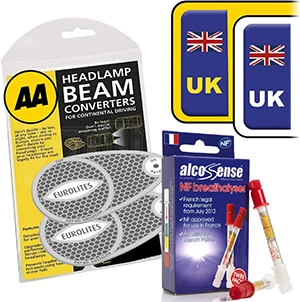
Includes 2 NF Certified AlcoSense Breathalysers, AA Eurolites Headlight Deflectors, and UK Number Plate Stickers for driving in France and Europe. Quick and easy compliance with simple instructions, ensuring safety and regulation adherence for your travels.


Low-Emission Zones
If your route includes Amsterdam, Rotterdam, or Utrecht, check your vehicle’s eligibility for low-emission zones (milieuzones).
Petrol vehicles registered after 1992 and diesels after 2005 are generally allowed, but older models can trigger fines automatically through number-plate recognition cameras. Clear white “Milieuzone” signs mark entry points, avoid them if your car doesn’t qualify.
For Dutch-registered vehicles, eligibility can be checked online via the official Milieuzonwjy es portal by entering the number plate. Drivers of foreign-registered vehicles should confirm their car’s Euro emission rating and compare it against the requirements listed for each city.
🇳🇱 Use the Milieuzone checker to confirm eligibility (Dutch-registered vehicles only).
Emergency Contacts and Breakdown Support
Save the following numbers before travelling:
- 112 – the EU-wide emergency number for police, fire, and ambulance.
- Your breakdown provider’s European helpline, usually printed on your policy documents.
If hiring a vehicle in the Netherlands, ensure the rental company supplies copies of insurance and registration papers. Dutch firms are meticulous about documentation and expect drivers to carry it at all times.
For any long-distance trip, prevention of breakdown is better than cure. If your journey involves extensive motorway mileage, consider booking a basic vehicle check with your local garage. Confirm tyre condition and pressures, fluid levels, battery health, and brake wear. Modern cars are reliable, but long continental drives place steady demands on cooling systems, tyres, and suspension.
It’s also sensible to carry a basic breakdown kit: warning triangle, high-visibility vests for each traveller, torch, and jump leads. While not all items are legally required in the Netherlands, they are useful in the event of a roadside stop or mechanical issue.
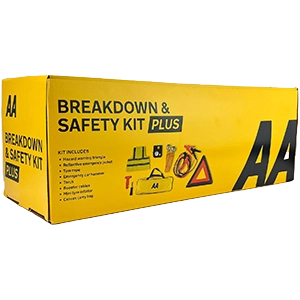
Stay prepared for roadside emergencies with this compact kit, including a warning triangle, reflective jacket, booster cables, tow rope, torch, emergency hammer, mini tyre inflator, and a durable carry bag.
Security and Overnight Stops
Car crime is rare but not unheard of near major ports and motorway rest areas. Choose well-lit, patrolled service areas for overnight stops and lock valuables out of sight. Most Dutch hotels and B&Bs provide private or gated parking; use it where possible. Even in a country known for safety, caution remains a form of courtesy.
Fuel and Payments


Unmanned petrol stations are common, particularly outside towns, and are usually card-only. Unmanned petrol stations are common, particularly outside towns, and are usually card-only.
Petrol is labelled benzine in the Netherlands.
- E10 (Euro 95) – standard unleaded petrol (suitable for most modern vehicles).
- E5 (Euro 98) – higher-octane, ethanol-free petrol, ideal for older engines. Premium 100 RON fuels are available at some larger stations (often branded as V-Power Racing or similar), but they are less widespread than 99 RON options in the UK.
- Diesel (B7) – clearly marked at the pump.
LPG (autogas) is still available but requires an adaptor and is not recommended unless your vehicle is designed for it. - LPG (autogas) remains available but requires a compatible vehicle and, in some cases, a fill adaptor.
Refuelling Etiquette
Dutch forecourts are clean and orderly, and self-service is standard. Switch off your engine completely, remain beside your vehicle while refuelling, and return the nozzle neatly. Leaving the pump area tidy is considered basic courtesy — part of the same driving culture that keeps the country’s roads calm and efficient.
Payments and Pricing
Most stations accept Visa, Mastercard, and contactless cards, though prepaid cards from UK banks occasionally fail at unmanned sites. In such cases, look for a staffed tankstation with a small shop attached. Fuel prices are displayed clearly in euros per litre and tend to be higher than in France or Belgium. If travelling north from Calais, refuel before crossing the border to save a few euros.
Tolls, Charging, and Rest Areas
The Netherlands has no general motorway tolls, but some bridges and tunnels, such as the Westerschelde Tunnel and parts of the Maasvlakte near Rotterdam, charge small fees payable by card.
Motorway rest areas are frequent, safe, and well-maintained, often featuring EV charging stations, clean facilities, and cafés serving fresh food rather than fast service chains. Charging points use Type-2 connectors, compatible with most UK electric vehicles.
Best Practice
Finally, avoid carrying spare fuel inside the vehicle cabin, as it’s illegal and unsafe. Plan fuel stops in advance, keep at least a quarter tank in rural areas, and take advantage of the Netherlands’ excellent roadside signage; every route is designed to keep drivers informed without distraction.
Enjoy your travels!
Save the Memory with Velocity GPS Dashboard

Make your trips more memorable. Convert speeds while on the move and record every detail with Velocity GPS Dashboard.
Learn more:
